Is SPC Flooring Really Waterproof and Durable?
SPC flooring is waterproof at the plank level, yet most complaints come from installation, locking systems and subfloor conditions. Here is what waterproof really means, why floors lift or locks break, and what to check before specifying SPC.
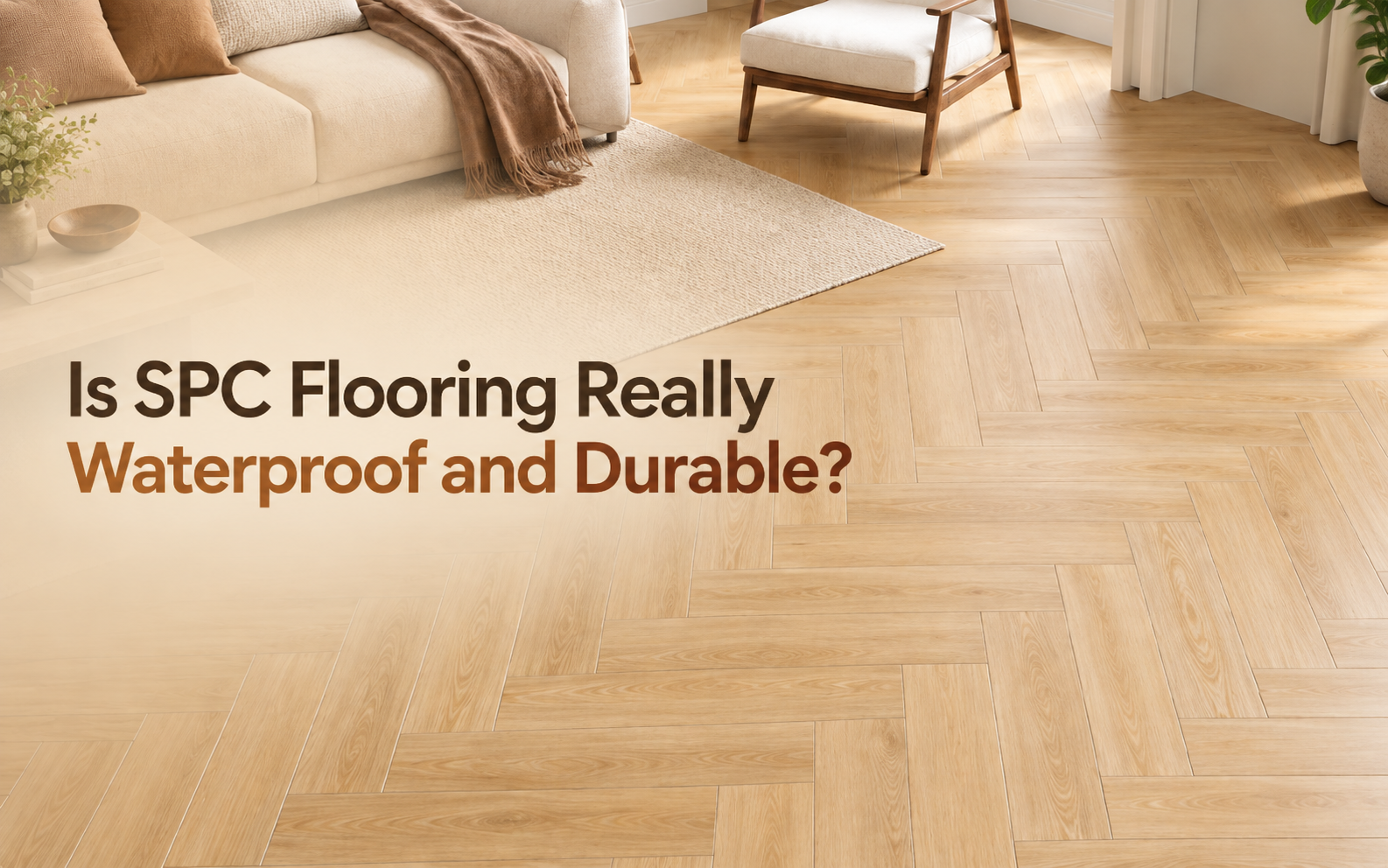
SPC flooring is often sold with a simple promise: it is waterproof, durable, and easy to maintain.
That promise is not wrong—but it is incomplete.
A well-made SPC floor can perform extremely well in kitchens, entryways, apartments, retail spaces, and many commercial interiors. It resists everyday spills, does not swell like wood-based flooring, and can handle regular foot traffic with minimal maintenance.
So why do some people complain about lifted edges, broken locks, gaps between planks, or floors that start clicking after installation?
The answer is that waterproof does not mean problem-proof. SPC flooring is only one part of the system. Its real-world performance depends on the product structure, locking design, subfloor condition, installation method, and how the finished floor is used.
Is SPC Flooring Actually Waterproof?
Yes. SPC flooring is waterproof at the plank level.
SPC stands for Stone Plastic Composite. Its rigid core is typically made from mineral powder, PVC resin, and stabilizers. Unlike wood, MDF, or many laminate cores, it does not absorb water in the same way. A spilled drink, wet shoes, or routine mopping will not normally make a quality SPC plank swell, rot, or lose its shape.
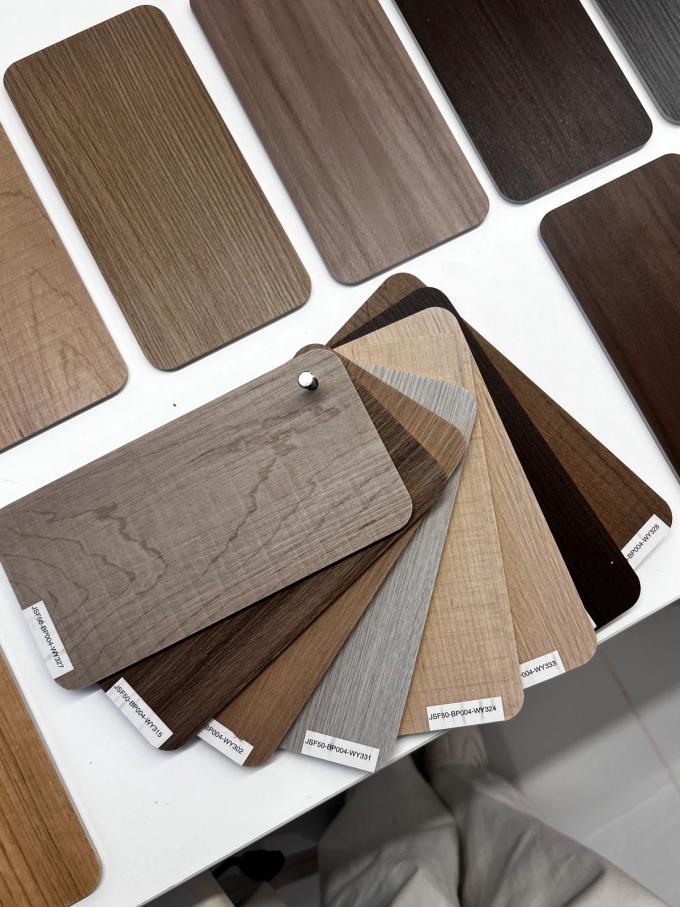
That is why SPC is often chosen for areas where moisture is a concern, including:
- Kitchens
- Entryways
- Rental properties
- Retail stores
- Hotel rooms
- Basements with suitable moisture control
- Bathrooms, when installed according to the supplier's instructions
However, there is an important difference between a waterproof plank and a completely waterproof flooring system.
For moisture-prone spaces, the best approach is to start with a dry, properly tested subfloor, follow the manufacturer’s expansion-gap requirements, and use suitable waterproof detailing around exposed edges and transitions. In bathrooms, kitchens, or entryways, installers should pay particular attention to perimeter sealing and areas where water may collect. This helps protect not only the SPC planks, but also the subfloor and the entire installation underneath.
If SPC Is Waterproof, Why Does It Sometimes Buckle or Lift?
When SPC flooring lifts, peaks, or appears to buckle, many people assume the planks absorbed water. In most cases, that is not the real cause.
Most SPC flooring is installed as a floating floor. The planks lock together and sit on top of the prepared subfloor rather than being fully fixed to it. This installation method requires a small expansion gap around walls, door frames, cabinets, pipes, and other fixed objects.
Without enough room to move, pressure can build up across the floor. Eventually, that pressure may force one section upward.
Common causes include:
- Insufficient expansion space at walls or doorways
- Flooring installed too tightly against cabinets or columns
- Heavy fixed furniture placed on top of a floating floor
- Large areas installed without suitable transitions
- Strong direct sunlight or significant temperature changes
- Uneven subfloors that place stress on the planks
- Moisture trapped below the flooring
- Incorrect installation around stair rails, islands, or built-in units
In short, SPC flooring may lift because it is restricted, not because the plank itself is no longer waterproof.
The correct installation steps are shown in the image below.
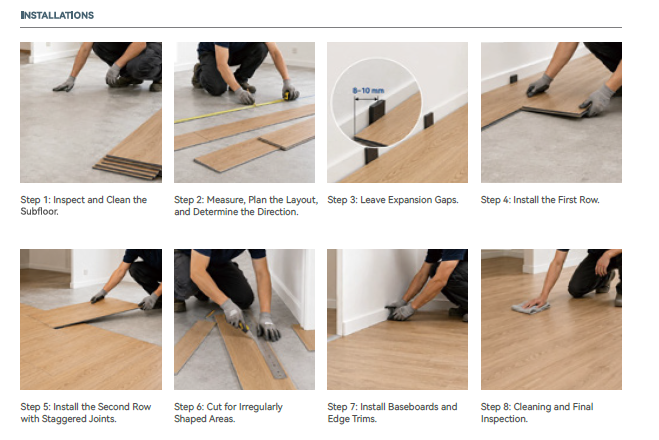
Why Do SPC Flooring Locks Break?
The locking system is one of the most important parts of a click-floor product.
A durable wear layer protects the decorative surface from scratches and stains. But the locking joint determines whether planks stay connected after installation.
If the locking system is weak, shallow, poorly milled, or stressed by an uneven subfloor, problems can develop over time. These may include:
- Open joints between planks
- Cracked tongues or grooves
- Chipped edges
- Clicking sounds when walking
- Loose corners
- Seams that separate in busy areas
This is why experienced flooring installers often pay close attention to the locking profile, not just the wear layer.
A floor may have a strong surface and still fail at the joint. For long-term performance, buyers should consider locking strength, core stability, production accuracy, and installation requirements together.
Is Cheap SPC Flooring Always a Bad Choice?
Not always. A lower-priced SPC floor can still be suitable for a light-use residential project with a flat, dry, well-prepared subfloor.
The issue is that lower price points often require compromises. Depending on the supplier, those compromises may involve thinner cores, less material around the locking system, simpler surface treatments, limited acoustic backing, or lower production tolerances.
These products can be more sensitive to installation conditions. A thin plank with a weak locking structure may work acceptably in one room but struggle in a large open-plan area, a busy retail shop, or a home with subfloor movement.
For projects with heavier use or higher service expectations, it is safer to look beyond price and compare the full construction of the product.
Does Thicker SPC Flooring Last Longer?
Thickness can help, but it is not the only answer.
A 6mm or 7mm SPC plank often has more material around the locking system than a 4mm or 5mm product. This may improve stability during installation and provide better resistance to impact and joint damage. Thicker construction can also allow space for an attached IXPE or EVA acoustic backing.
Still, thickness alone does not guarantee quality.
A thick plank with a weak core or poorly designed locks can create problems. At the same time, a thinner plank made with a stable formula, precise milling, and a reliable locking system can perform well in the right environment.
When comparing SPC flooring, consider thickness together with:
- Core construction
- Locking system strength
- Wear layer
- Attached backing
- Dimensional stability
- Intended application
- Subfloor requirements
Why Does SPC Flooring Feel Hard or Sound Loud?
SPC flooring has a dense, rigid core. That rigidity is one reason it resists dents and maintains its shape well. But it also means SPC often feels firmer underfoot than WPC flooring, carpet, or some softer vinyl products.
Without an acoustic backing, SPC can also produce more footfall noise.
This is not necessarily a defect. It is a characteristic of rigid-core flooring. For apartments, hotels, offices, bedrooms, and upper-floor spaces, an IXPE or EVA backing can make a noticeable difference in walking comfort and sound reduction.
If a project requires a softer feel and stronger acoustic performance, WPC flooring may be worth considering. If dent resistance, water resistance, and structural rigidity are the priority, SPC is often the better fit.
Is SPC Flooring Durable Enough for Commercial Use?
Many SPC products are suitable for commercial interiors. However, a "commercial" label alone is not enough to determine whether a floor is right for a project.
Before selecting SPC for a commercial space, consider:
- Expected daily foot traffic
- Rolling loads from carts or luggage
- Heavy furniture and fixtures
- Exposure to sunlight and temperature changes
- Subfloor flatness and moisture condition
- Cleaning routines
- Noise requirements
- Maintenance and replacement needs
For high-traffic environments, a stronger locking system, thicker construction, higher wear-layer specification, or glue-down installation may be more appropriate than a basic residential floating-floor product.
The product should be selected for the project—not simply for the lowest price or the broadest marketing claim.
How to Avoid Common SPC Flooring Problems
Most SPC flooring complaints can be reduced with better product selection and installation planning.
Before purchasing or installing, confirm the following:
- Is the subfloor flat enough for the product?
- Has the subfloor been tested for moisture?
- What expansion gap does the supplier require?
- Is the locking system designed for the expected traffic level?
- Is the product suitable for direct sunlight or underfloor heating?
- Does it include IXPE or EVA backing?
- Is floating installation or glue-down installation more suitable?
- What technical documents, certifications, and warranty support are available?
These questions are especially important for distributors, contractors, developers, and hospitality projects where a flooring issue can lead to expensive callbacks.
Final Thoughts
SPC flooring is genuinely waterproof at the plank level, and a quality product can be highly durable. It does not swell like wood-based flooring, it is easy to clean, and it works well in many residential and commercial settings.
But SPC is not a universal solution that can overcome poor installation, weak locks, uneven subfloors, or unrealistic price expectations.
The best results come from choosing the right product for the space, preparing the subfloor properly, following installation requirements, and working with a supplier that understands the technical details behind the product.
When those factors are in place, SPC flooring delivers exactly what buyers expect: a practical, attractive, and low-maintenance floor built for everyday use.
FAQ
Can SPC flooring be used in bathrooms?
Yes, SPC flooring can be used in bathrooms because the plank itself is waterproof. However, perimeter sealing, subfloor moisture control, and correct installation are still important.
Can water get underneath SPC flooring?
Yes. Water can enter through perimeter gaps, damaged joints, doorways, or moisture from the subfloor. Waterproof planks do not eliminate the need for proper installation.
Does SPC flooring expand and contract?
SPC is more dimensionally stable than many other flooring materials, but floating floors still require expansion space around fixed objects and room perimeters.
Why is my SPC flooring separating?
Common causes include a weak locking system, uneven subfloor, improper installation, insufficient expansion space, or repeated movement under traffic.
Is SPC flooring better than laminate for kitchens?
SPC is generally a safer option for kitchens because it is waterproof at the plank level. Laminate may be damaged if water reaches its core or edges.