Flexible Stone Wall Panels: A Smarter Way to Create Stone Interiors
Learn what flexible stone is, how it is made, how it compares with other wall materials, and how to install flexible stone on flat walls, curves, and columns.
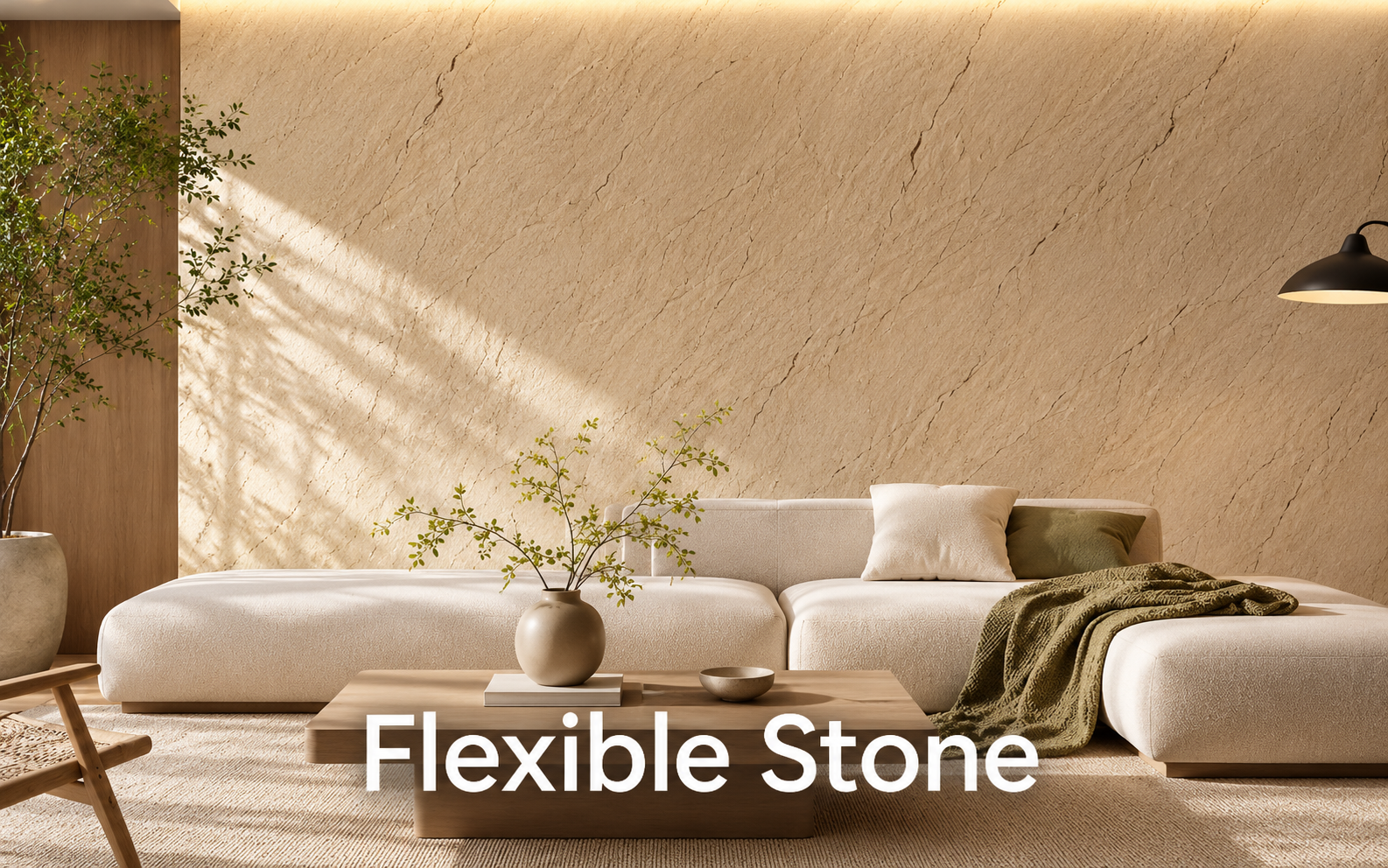
Flexible stone, often called MCM Flexible Stone, is a lightweight decorative surfacing material made primarily from modified inorganic materials. It combines natural mineral particles, a special emulsion, curing agents, and additives to create a thin, stone-look architectural finish.
Its surface can reproduce a wide range of textures, including travertine, rammed earth, slate, concrete, granite, fabric, and mosaic patterns.
1. What Is Flexible Stone? Materials and Structure
A typical flexible stone formulation may include:
- Natural mineral particles: approximately 85%
- Special emulsion: approximately 12%
- Curing agents and additives: approximately 3%
The actual formulation may vary depending on the texture, thickness, and flexibility required for each product.
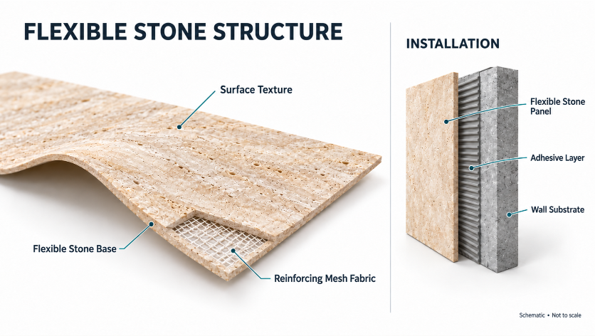
In terms of structure, flexible stone normally consists of a decorative surface layer, an MCM composite body, and a reinforcing mesh layer. During production, the material is laid up with mesh reinforcement to improve overall stability. Some products receive additional surface decoration after forming, such as hand wiping, UV digital printing, or inorganic ink printing.
Flexible stone is commonly available in thicknesses of approximately 2.5–10 mm, with a decorative surface weight of around 4–7 kg/m². Certain 2–3 mm thin models can be tested for use on curved walls or columns, but flexibility should never be assumed for every design.
2. Five Key Features of Flexible Stone
Lightweight
With a typical surface weight of around 4–7 kg/m², flexible stone places less load on the wall than natural stone. It is easier to handle during installation and is suitable for renovation projects, feature walls, and selected exterior applications.
Thin Profile
Most flexible stone products are only 2.5–10 mm thick, so they take up little wall space. This can be useful for interior renovations, door openings, wall corners, and areas where finished dimensions need close control.
Flexible Options for Curved Surfaces
Certain 2–3 mm thin models can be tested for curved walls and column wrapping. Thicker products or designs with deep textures should not be assumed to bend.
Straightforward Installation Process
The installation process generally includes substrate preparation, adhesive application, pressing the panel into place, joint treatment, and surface cleaning. Actual installation should follow the instructions for the selected SKU and adhesive system.
Diverse Textures and Colours
Flexible stone can create the appearance of travertine, slate, rammed earth, cast concrete, flamed stone, fabric textures, flowing stone, and mosaics. It can be used in homes, hotels, retail spaces, showrooms, and selected exterior wall applications.
3. Flexible Stone Compared with Other Wall Materials
| Material | Weight | Flexibility | Installation | Texture & Appearance | Best For |
|---|---|---|---|---|---|
| Flexible Stone | Lightweight | Good | Glue installation; suitable for flat and selected curved surfaces | Natural stone, marble, concrete, travertine, and sandstone effects | Feature walls, commercial interiors, curved walls, and columns |
| Ceramic Tile | Heavy | None | Requires adhesive, grout, and skilled installation | Hard surface with consistent decorative patterns | Bathrooms, kitchens, and high-wear wall areas |
| Paint | Very lightweight | Not applicable | Simple roller or spray application | Smooth finish; limited three-dimensional texture | Quick and budget-friendly wall decoration |
| Natural Stone-Look Coating | Lightweight | Not applicable | Applied in multiple coating layers | Stone-like visual effect with limited depth | Exterior façades and decorative walls |
| Natural Stone | Very heavy | None | Requires strong substrate support and professional installation | Authentic natural texture and variation | High-end façades, lobbies, and luxury projects |
| PS Wall Panels | Lightweight | Low | Simple adhesive or clip installation | Wood grain, fluted, and decorative panel effects | Interior decorative walls and residential projects |
| PVC Wall Panels | Lightweight | Low | Quick installation with adhesive or framing | Smooth, printed, or decorative finishes | Moisture-prone interior areas and cost-sensitive projects |
| SPC Wall Panels | Medium weight | Low | Installed with adhesive or mechanical fixing | Rigid stone, marble, wood, or decorative surface effects | Commercial interiors, bathrooms, and durable wall applications |
4. Production Methods and Risk Considerations
Flexible stone obtains its colour and visual effect mainly through four methods: slurry colouring, hand wiping, UV digital printing, and inorganic ink printing.
| Production Method | How It Works | Surface Effect | Main Advantage | Risk or Consideration |
|---|---|---|---|---|
| Slurry Coloring | Color is mixed into the material before forming | Color runs through the material with a more integrated appearance | More consistent base color and natural-looking finish | Color variation may occur between production batches |
| Manual Surface Wiping | Color is applied manually after the sheet is formed | Layered, handcrafted, and more varied texture | Can create a richer and more natural stone-like effect | Manual application may lead to greater variation between pieces |
| UV Digital Printing | Patterns are digitally printed and cured by UV light | Precise patterns and a wide range of decorative designs | High design flexibility and efficient pattern reproduction | Outdoor exposure may cause color fading over time |
| Inorganic Ink Digital Printing | Inorganic pigment-based ink is digitally printed and dried at low temperature or naturally | More mineral-like visual effect with detailed pattern options | Can achieve a more natural stone appearance | Color stability and weather resistance should be verified for each application |
UV refers to a curing method, while inorganic ink refers to a pigment system. They are not always mutually exclusive. Actual performance depends on the selected ink, substrate, surface protection, and application environment.
5. How to Install Flexible Stone
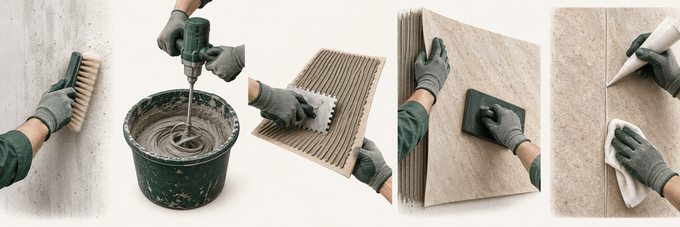
1) Prepare the Substrate
Check that the wall is sound, flat, dry, and free from hollow areas or major cracks. For very smooth substrates, roughen the surface or apply an interface agent to improve adhesion.
2) Mix the Adhesive
Use the recommended adhesive for the selected product. Mix it according to the required ratio until the material is smooth and uniform.
3) Apply Adhesive
Apply adhesive evenly to the back of the panel. For large panels, use double-sided adhesive application where required by the installation method.
4) Position and Press the Panel
Place the panel onto the prepared wall and press from the centre outward with a rubber float or similar soft tool. Do not strike the surface with hard tools.
5) Treat Joints and Clean the Surface
Install with open joints or tight joints according to the design. Complete the joint treatment and remove any adhesive residue before it cures.
6. Curved Walls and Column Wrapping
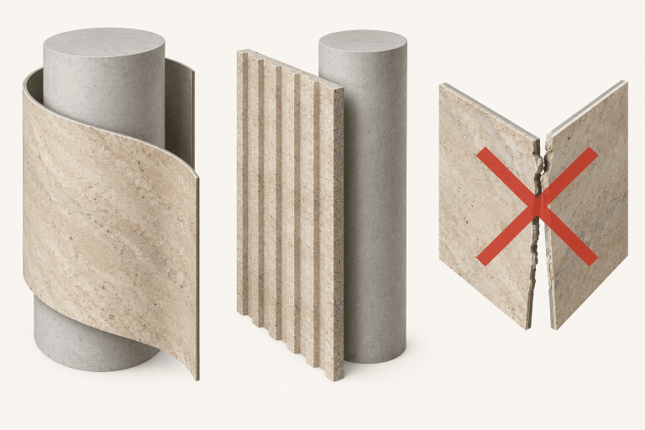
The flexibility of flexible stone depends on its thickness, texture, and substrate structure. Always test the exact model before using it on a curve or column.
- Some 2–3 mm thin models may be suitable for curved walls and round columns.
- A column diameter of 20 cm or above can be used as an initial reference, but on-site sample testing remains necessary.
- An 8 mm thick panel should not be promised for wrapping a 15 cm diameter column without technical evaluation and sample testing.
- Thick panels and deeply textured designs may experience stress or surface damage when bent and should not be used directly on small-radius columns.
- No flexible stone product should be folded during handling, cutting, or installation.
Before column wrapping, measure the column diameter, inspect the substrate, and install a sample of the same model. Confirm the curvature, layout direction, joint location, and adhesive method before full installation.
7. Frequently Asked Questions
Can flexible stone be used outdoors?
Yes, but the selected product, substrate, and installation system must be confirmed. Printed products may fade more quickly under UV exposure, so weathering documents and warranty terms should be checked for the specific model.
Can flexible stone wrap columns?
Some thin models can be tested for column wrapping. Please provide the column diameter, product model, and site photos. Always conduct a trial installation using the same product. Never fold the sheet.
Can it be installed over an existing wall finish?
Yes, provided that the existing surface is sound, flat, dry, and compatible with the adhesive. A small trial area is recommended before full installation.
Is flexible stone waterproof?
The surface has a degree of water resistance, but flexible stone is a decorative wall finish, not a waterproofing layer. It is not recommended for prolonged immersion or direct shower areas.
Will there be colour variation?
Colour variation may occur between different production batches due to raw materials, pigments, and inks. Approved samples and agreed acceptance criteria should be used as the reference. Confirm colour codes, batches, and retained samples for repeat orders.
Will the surface shed powder or scratch easily?
Avoid hard scraping and repeated abrasion. Use protective separator sheets during handling, and avoid sharp tools or aggressive cleaning methods after installation.
What are the lead time and MOQ for customised designs?
Sampling may take approximately 1–2 weeks. Final lead time and MOQ depend on the selected SKU, texture, size, and order quantity.
What about warranty and service life?
Some project references may indicate a five-year indoor warranty, a three-year outdoor warranty, an approximate service life of 20 years, and suitability for temperatures down to -20°C. All external commitments must follow the test reports, contract terms, and formal warranty documents for the specific SKU.